
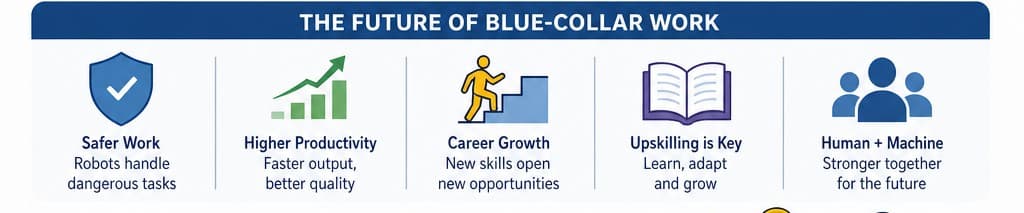
AI and Robotics Are Automating Core Physical Tasks
In both manufacturing and logistics, AI‑powered robotic systems are increasingly capable of performing tasks once considered exclusively human. Robots can now execute complex movements, adapt to variable environments, and make decisions in real time — a leap driven by advances in “physical AI,” which enables machines to perceive, learn, and act autonomously. These systems are already deployed in next‑generation fulfillment centers, where they handle picking, packing, sorting, and transporting goods with speed and precision.
In manufacturing, robotics has expanded far beyond welding and material handling. Modern robots perform intricate assembly, inspection, and quality‑control tasks with high accuracy, allowing human workers to shift toward oversight, coordination, and process improvement roles.
Blue‑Collar Roles Are Changing — Not Disappearing
While automation does replace certain repetitive or hazardous tasks, it also creates new categories of work. As robots take on physically strenuous labor, human workers increasingly focus on troubleshooting, system monitoring, and decision‑making. This shift is generating demand for roles such as robotics maintenance specialists, automation technicians, and industrial IoT engineers — positions that blend mechanical skills with digital fluency.
In logistics, the transformation is even more pronounced. Up to 60% of logistics jobs are undergoing AI‑driven change, yet most workers lack access to training, leaving a significant skills gap. Many warehouse operators, for example, are transitioning from manual picking to supervising automated systems, programming robotic equipment, or analyzing data from smart sensors.
Labor Shortages Are Accelerating Automation
The rapid adoption of robotics is not only driven by efficiency goals but also by severe labor shortages. The logistics sector faces acute gaps across warehousing, trucking, and dock work, with more than 3 million truck driver positions unfilled worldwide. AI‑enabled robots are increasingly deployed to stabilize operations, handle variable workflows, and support aging or insufficient workforces.
Manufacturers and logistics companies are also struggling to hire workers with the technical skills needed to operate and maintain advanced systems. As automation scales, competition for technically skilled blue‑collar talent is expected to intensify.
Upskilling Becomes Essential — But Access Lags Behind
The shift toward AI‑augmented work requires significant upskilling, yet only 28% of logistics workers report access to training, despite widespread job transformation. This mismatch between technological adoption and workforce development is emerging as one of the sector’s most urgent challenges.
Community colleges, employers, and local organizations are beginning to build training pipelines aligned with new skill demands, but experts warn that a comprehensive national talent strategy is needed to prevent long‑term displacement.
New Opportunities — and New Inequalities
AI and robotics adoption is creating a dual reality for blue‑collar workers:
Opportunity for those who can transition into higher‑skill, better‑paying technical roles.
Risk for workers without access to training, who may face reduced hours, job displacement, or stagnant wages.
Automation is also reshaping perceptions of fairness in the sector. Despite rising demand for labor, fewer than half of logistics workers feel fairly compensated, highlighting a growing disconnect between employer hiring activity and worker sentiment.
The Future: Human‑Robot Collaboration, Not Replacement
Across both manufacturing and logistics, the emerging consensus is that robots will not eliminate blue‑collar work — they will redefine it. Workers will increasingly “work with robots, not like robots,” taking on roles that emphasize judgment, adaptability, and technical oversight.
As AI continues to advance, the most resilient blue‑collar jobs will be those that combine hands‑on expertise with the ability to manage, maintain, and collaborate with automated systems.